A commissioned article for the Jewish Heritage Network on its latest innovation: an AI research agent that reconstructs personal histories across archives and dispersed sources.


The traces that endure are often fragmented. A name in a register, a transport list, an archival file. These records document events with precision, but they rarely convey the full texture of a life. In some cases, other materials exist elsewhere: photographs, audio recordings, local publications, or personal documents that reveal different aspects of the same individual. Yet these fragments are typically dispersed across institutions, collections, and systems that are not easily connected. This fragmentation is not new, but it becomes more visible as direct memory recedes. Without the ability to rely on witnesses, historical understanding increasingly depends on how well these dispersed traces can be accessed and related to one another.
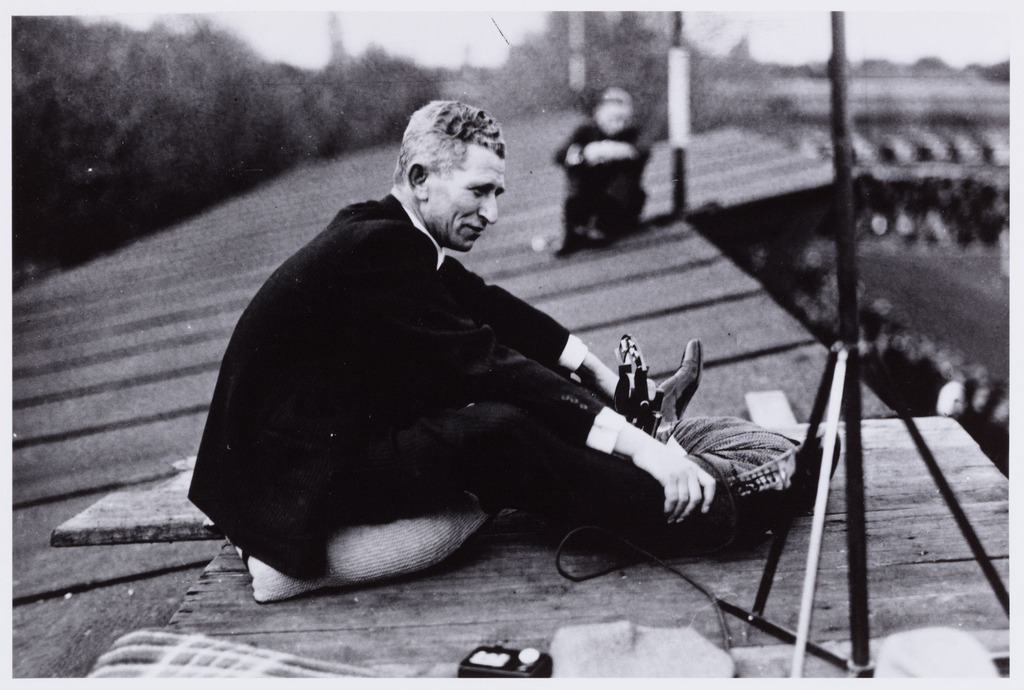
Take Han Hollander (1886–1943). Those who search for his name in major Holocaust records will mainly find a date and a transport—the administrative trace of his death in a concentration camp in Poland. Yet elsewhere, another trace exists. In audiovisual archives, footage has been preserved in which Hollander speaks, laughs, and jokes during an encounter with two world chess champions.
For pre-war Dutch audiences, his voice was once instantly recognizable—he was one of the country’s most well-known radio commentators. Now that generation has largely disappeared, what remains is mostly a name. That is precisely why such findings matter: they do not only restore facts, but also the person behind them.
The connection between these two worlds—the victim in one archive and the charismatic commentator in another—does not arise automatically. In Holocaust records, Hollander appears as a name in an administrative file. In audiovisual collections, he surfaces as a radio commentator within material catalogued under chess championships. Without a link between these separate archives, this fragment would likely remain invisible to anyone searching only by his name.
This is where recent developments in AI-based research tools are attempting to intervene. Systems such as AIGEN are designed to search across historical archives, identify connections between sources, and support the reconstruction of personal histories. The technology was developed within Stolperstories as part of the Jewish Heritage Network, an initiative focused on family histories and life stories related to the Holocaust, supported by the German Claims Conference. The platform is still under development, with AIGEN presented around May 4 as an initial public step and technological foundation.
Family research often begins with limited information: a name, a date, a place. From there, it moves into a complex landscape of archives and databases. While many countries have invested heavily in digitisation, accessibility remains uneven. Collections are spread across institutions, described in different ways, and often exist in multiple languages. Some materials are well indexed; others are not. For specialists, navigating this landscape is part of the work. For non-specialists, it can be difficult to know where to begin.
This gap has become more visible in recent years, particularly as public interest in family history has grown. What was once seen as a niche or specialist activity is increasingly part of a broader search for identity and context. People look for explanations for migration, gaps in family narratives, or connections that were previously unknown or unspoken.
At the same time, expectations around access have changed. Digital tools have made information searchable and immediate in many domains, creating a contrast with the slower, more fragmented nature of archival research.
Within this context, artificial intelligence is beginning to play a role. Not as a replacement for archives or historical expertise, but as a potential tool for navigating large, complex datasets.
Recent developments have focused on applying AI to tasks such as handwriting recognition, metadata generation, and search optimisation. Increasingly, there is also interest in systems that can identify connections between sources—linking records that refer to the same individual across different collections, even when names, spellings, or contexts vary.
This reflects a broader shift: from simply digitising archives to making them more navigable and relational. At the same time, these developments raise important questions. Historical data is often incomplete, ambiguous, or contradictory. Any system that attempts to connect sources must deal with uncertainty and interpretation. Issues of reliability, transparency, and bias are therefore central to how AI can be used responsibly in this domain.
There are also structural considerations. Archives operate within public frameworks, with responsibilities around preservation, access, and ethics. Integrating new technologies into these systems requires careful alignment with those values, as well as attention to data ownership, privacy, and long-term sustainability.
As the distance from the Second World War increases, remembrance itself is evolving. Traditionally, it has relied on testimony, ceremony, and collective rituals. These remain important, but they are no longer the only forms through which the past is engaged.
There is a growing emphasis on individual stories—on understanding not only how people died, but how they lived. This involves looking beyond official records of persecution to reconstruct everyday life: relationships, professions, routines, and local environments.
Such perspectives often depend on combining different types of sources. A formal record may establish a date or event, while a photograph, a newspaper mention, or a fragment of audio can provide a different kind of insight. When these elements are brought together, they can shift the way history is perceived—from abstract or statistical to personal and situated.
In this sense, remembrance becomes less about a single narrative and more about assembling multiple traces into a more nuanced picture.
The increasing use of digital tools, including AI, highlights a broader transition in how societies engage with the past. The challenge is no longer only to preserve information, but to ensure that it can be found, understood, and connected. This does not mean that technology resolves the complexities of historical research. Archives remain essential as custodians of context and meaning. Nor does it remove the need for critical interpretation; if anything, it makes it more important.
What it does suggest is that the conditions of access are changing. As direct memory fades, the ability to navigate dispersed sources becomes more central to how history is reconstructed.
The question, then, is not whether technology replaces traditional forms of remembrance, but how it might complement them—by making existing material more visible, more connected, and more open to inquiry.
In that sense, the future of remembering may depend less on creating new information than on learning how to work more effectively with what is already there.
Written for the Jewish Heritage Network for May 4, this article accompanies the launch of AIGEN, a research tool developed to navigate and connect historical archives. Image: Han Hollander during football game Willem II & Ajax, via het Regionaal Archief Tilburg.
Building the storytelling and creative identity of Imane Cooking Atelier while exploring the cultural traditions behind Morocco's century-old hosting culture.

For Casawi Magazine, a look at Amsterdam-based studio Solid Nature and its reimagining of marble, geology and nature through contemporary design.